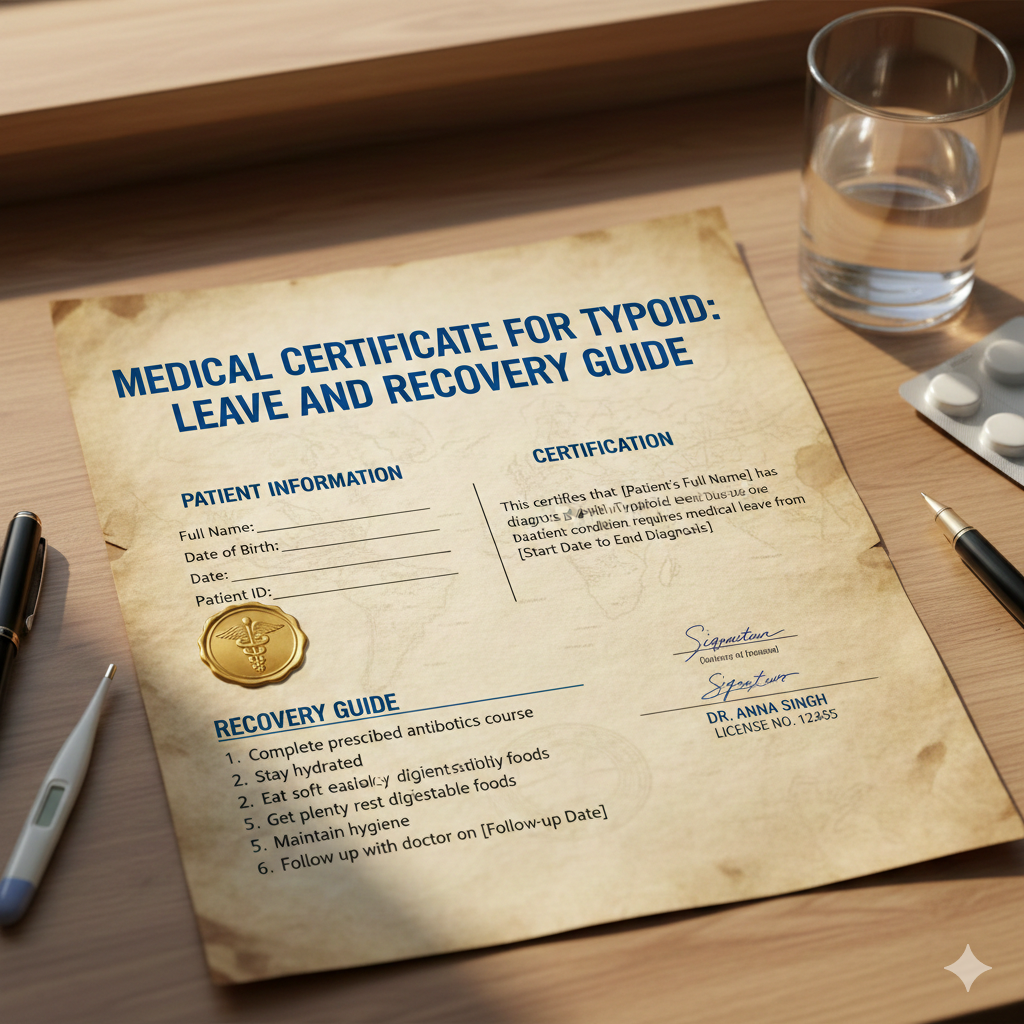
Medical Certificate for Pink Eye (Conjunctivitis): Your Complete Guide to Workplace Documentation
Medical Certificate
Pink eye doesn’t wait for convenient office hours. When you wake up with crusty, inflamed eyes and realize you’re potentially contagious, the last thing you need is confusion about medical documentation. Whether you’re facing skeptical employers, concerned school administrators, or anxious coworkers, understanding how to obtain a proper medical certificate for conjunctivitis can mean the difference between appropriate isolation and workplace exposure incidents.

Conjunctivitis, commonly known as pink eye, affects millions of people annually and remains one of the most contagious conditions in workplace and educational settings. The stakes are straightforward: without proper documentation, you may face pressure to attend work or school while infectious, potentially triggering outbreaks that affect dozens of people. With the right medical certificate, you protect both yourself and your community while maintaining professional credibility.
This comprehensive guide walks you through everything you need to know about securing medical certificates for conjunctivitis, from understanding isolation protocols to leveraging telehealth services for rapid documentation.
Medical Certificate for Pink Eye (Conjunctivitis)
A medical certificate for conjunctivitis serves as official documentation that verifies your diagnosis and justifies your absence from work, school, or other obligations. Unlike a simple sick note, a proper conjunctivitis certificate should include specific details: the diagnosis of conjunctivitis (specifying bacterial, viral, or allergic if determined), the date of examination, the recommended isolation period, and any restrictions on activities.
Healthcare providers issue these certificates after assessing your symptoms and determining the likely type of conjunctivitis. The certificate acts as legal protection for both employee and employer—it validates your absence while ensuring workplace health and safety protocols are followed. In many jurisdictions, employers cannot legally question the validity of a properly formatted medical certificate, though they can verify its authenticity with the issuing provider.
The timing of obtaining your certificate matters significantly. Most workplace policies require notification within 24 hours of absence, and many specifically request medical documentation for absences exceeding one or two days. For conjunctivitis, given its contagious nature, many employers and schools mandate a certificate before allowing your return, not just to justify the absence.
Modern medical certificates for pink eye increasingly come from telehealth consultations, which we’ll explore in detail later. These digital certificates hold the same legal weight as in-person documentation, provided they’re issued by licensed healthcare professionals and meet your jurisdiction’s requirements.
The Protocol for Eye Infections at Work/School
Workplace and educational institution protocols for eye infections follow public health guidelines designed to prevent outbreaks. Most organizations implement a zero-tolerance approach to suspected infectious conjunctivitis, requiring immediate removal from the premises upon symptom identification.
The Centers for Disease Control and Prevention (CDC) and similar health authorities worldwide recommend that individuals with bacterial or viral conjunctivitis remain home until symptoms improve significantly or until they’ve completed at least 24 hours of prescribed antibiotic treatment for bacterial cases. Schools often enforce stricter protocols, sometimes requiring complete resolution of symptoms before allowing students to return, particularly in younger age groups where hygiene practices may be less reliable.
Professional environments typically require a return-to-work medical clearance certificate in addition to the initial sick leave documentation. This creates a two-certificate process: one to justify your absence and another to authorize your return. Both serve important functions—the first protects coworkers during your contagious period, while the second provides assurance that you’re no longer a transmission risk.
Food service, healthcare, childcare, and education sectors face particularly stringent requirements. Workers in these fields may be subject to immediate suspension without documentation and face mandatory medical clearance before returning. Some employers in high-risk sectors maintain relationships with occupational health services specifically to expedite these evaluations and prevent extended workforce disruptions.
Understanding your organization’s specific protocol before you get sick saves critical time. Review your employee handbook or student guidelines to identify notification procedures, documentation requirements, and clearance processes. Many people discover these requirements only after getting sick, leading to unnecessary complications and extended absences.
Why Isolation is Mandatory
Conjunctivitis isolation isn’t merely suggested—it’s mandatory in most organized settings for compelling epidemiological reasons. Viral and bacterial conjunctivitis rank among the most easily transmissible conditions, spreading through direct contact, contaminated surfaces, and even respiratory droplets in some cases.
The transmission mathematics are stark. A single person with viral conjunctivitis can potentially infect everyone who touches surfaces they’ve contaminated, from doorknobs to keyboards to shared phones. The pathogens responsible for bacterial conjunctivitis can survive on surfaces for hours or even days, creating extended contamination windows. In closed environments like offices, schools, or public transportation, infection rates can reach 50% or higher among close contacts without intervention.
Children face particularly high risk because hand-to-face contact frequency in young populations far exceeds that of adults. Pediatric conjunctivitis outbreaks in schools or daycare centers can spread rapidly through entire classrooms within 48-72 hours. This explains why schools often implement aggressive exclusion policies that may seem excessive but are epidemiologically justified.
The economic impact of conjunctivitis outbreaks extends beyond individual illness. Workplace outbreaks create cascading absences that can cripple productivity, particularly in small businesses or specialized departments. The cost of prevention through isolation of affected individuals dramatically undercuts the expense of treating multiple infections and managing widespread absences.
From an ethical standpoint, attending work or school while knowingly contagious with conjunctivitis represents a failure of community responsibility. While individual symptoms may seem minor—some people experience only mild irritation—the collective impact of transmission can be severe, particularly for vulnerable individuals who may develop complications.
How Telehealth Diagnoses Eye Flu
Telehealth has revolutionized conjunctivitis diagnosis and medical certificate issuance, offering rapid assessment without the need to visit healthcare facilities while potentially contagious. The process leverages high-resolution video technology that allows healthcare providers to conduct detailed visual examinations remotely.
During a telehealth consultation for suspected pink eye, providers typically request that you position yourself in good lighting—preferably natural daylight near a window—and use your device’s camera to show your affected eye or eyes from multiple angles. Modern smartphone cameras provide sufficient resolution to identify key diagnostic features: the pattern and degree of redness, the presence and type of discharge, eyelid swelling, and the distribution of inflammation.
Providers can distinguish between viral, bacterial, and allergic conjunctivitis with reasonable accuracy through visual assessment combined with symptom history. Viral conjunctivitis typically presents with watery discharge and may accompany upper respiratory symptoms. Bacterial conjunctivitis often produces thick, yellow-green discharge and more pronounced crusting. Allergic conjunctivitis usually affects both eyes symmetrically and occurs alongside other allergy symptoms like sneezing or nasal congestion.
The diagnostic accuracy of telehealth for conjunctivitis compares favorably with in-person assessment in many cases. While providers cannot perform certain specialized tests remotely—like fluorescein staining to detect corneal abrasions—these tests aren’t necessary for straightforward conjunctivitis diagnosis. Most cases present with classic symptoms that experienced providers can identify visually.
Importantly, telehealth providers know when remote assessment is insufficient. They’ll refer you for in-person evaluation if they observe concerning features: significant pain, marked vision changes, suspected corneal involvement, or symptoms suggesting serious alternative diagnoses like uveitis or acute angle-closure glaucoma. This built-in safety net ensures that telehealth remains appropriate for routine cases while escalating complex situations to higher levels of care.
The efficiency advantage of telehealth for conjunctivitis is substantial. Traditional healthcare visits might require hours between scheduling, travel, waiting rooms, and the appointment itself—all while you’re contagious and symptomatic. Telehealth consultations often occur within hours or even minutes of request, and you receive your medical certificate digitally, sometimes within minutes of your consultation ending.
Visual Assessment and Symptoms
Healthcare providers assessing conjunctivitis—whether through telehealth or in-person—rely on a constellation of observable signs and reported symptoms to reach their diagnosis. Understanding what providers look for helps you prepare for your consultation and provide relevant information efficiently.
The primary visual indicators include conjunctival injection (redness of the eye’s white portion), discharge characteristics, eyelid edema (swelling), and the pattern of inflammation. Providers note whether redness is diffuse or localized, whether it affects one or both eyes, and how it distributes across the conjunctival surface. These details help differentiate conjunctivitis types and rule out other conditions.
Discharge analysis provides crucial diagnostic information. Watery, clear discharge suggests viral etiology or allergic causes. Thick, purulent discharge indicates bacterial infection. Stringy, mucoid discharge often points to allergic conjunctivitis. The discharge’s color, consistency, and volume all factor into diagnosis.
Symptom history complements visual findings. Providers ask about symptom onset, progression, and associated features. Key questions include: Did symptoms begin suddenly or gradually? Are you experiencing itching (suggesting allergy) or pain (suggesting complications)? Have you had recent cold symptoms or exposures to people with similar eye problems? Do you wear contact lenses (raising concerns about specific bacterial infections)?
The unilateral versus bilateral presentation matters significantly. Viral conjunctivitis often starts in one eye and spreads to the other within days. Bacterial conjunctivitis may affect one or both eyes initially. Allergic conjunctivitis almost always affects both eyes simultaneously. This temporal pattern provides diagnostic clues.
Additional signs that providers assess include preauricular lymphadenopathy (swollen lymph nodes in front of the ear, common in viral conjunctivitis), visual acuity changes, light sensitivity, and foreign body sensation. These factors help distinguish simple conjunctivitis from conditions requiring more aggressive intervention.
For telehealth consultations specifically, providers may request that you gently pull down your lower eyelid to visualize the inferior conjunctiva, look up while holding your upper lid to show the inferior portion of your eye, and demonstrate your eye’s range of motion. These maneuvers, combined with your description of symptoms, typically provide sufficient information for confident diagnosis in straightforward cases.
Getting Your Quarantine Note
Securing your quarantine note or medical certificate for conjunctivitis involves several practical steps, and understanding the process helps you obtain documentation quickly while managing symptoms.
Step 1: Recognize When You Need a Certificate
Not every case of pink eye requires formal documentation. For brief, self-limiting symptoms that don’t impact your obligations, no certificate may be necessary. However, you definitely need documentation if: you’re missing work or school, your employer or institution specifically requests it, you need to justify sick leave for payroll purposes, you’re seeking insurance reimbursement, or organizational policy requires medical clearance before return.
Step 2: Choose Your Healthcare Provider Route
You have several options: telehealth services (fastest, most convenient for straightforward cases), your primary care physician (best if you have an existing relationship and can get a same-day appointment), urgent care clinics (good for after-hours needs but involves in-person visit while contagious), or occupational health services (if your employer provides them).
Telehealth represents the optimal choice for most conjunctivitis cases because it’s fast, prevents disease spread, and specifically caters to straightforward diagnoses like pink eye. Many telehealth platforms offer services specifically marketed for sick notes and medical certificates, understanding this common need.
Step 3: Prepare for Your Consultation
Before your appointment, gather relevant information: your symptom timeline, any home treatments you’ve tried, current medications, relevant medical history (particularly previous eye infections, contact lens use, or eye conditions), and your employer’s or school’s specific documentation requirements.
Position yourself in good lighting for telehealth appointments, and have your device angled so the provider can clearly see your face and eyes. Clean any discharge from your eyes immediately before the appointment so the provider can assess the eye itself.
Step 4: The Consultation
Describe your symptoms clearly and chronologically. Be specific about when symptoms started, how they’ve progressed, and what you’ve experienced. Mention any known exposures to others with similar symptoms. Answer the provider’s questions directly and thoroughly.
The provider will conduct their assessment and likely offer treatment recommendations. For bacterial conjunctivitis, this typically means antibiotic eye drops or ointment. For viral conjunctivitis, supportive care recommendations like cool compresses and artificial tears. For allergic conjunctivitis, antihistamine drops or oral antihistamines.
Step 5: Request Your Certificate Explicitly
While some providers automatically offer medical certificates, others wait for you to request one. Be direct: “I need a medical certificate for my employer documenting this diagnosis and recommending isolation for [X] days.” If you need specific wording or details included, mention this. Some employers require specific language about contagiousness or fitness to return to work.
Step 6: Verify Certificate Details
Before ending your consultation, confirm the certificate includes: the date of examination, your name and date of birth, the diagnosis (conjunctivitis or more specific typing if determined), the recommended absence period, the provider’s name, license number, and signature, and any return-to-work or return-to-school criteria.
Step 7: Receive and Submit Documentation
Most telehealth services deliver certificates electronically via email or through their app, usually within hours or even minutes. Download and save multiple copies. Submit to your employer or institution according to their preferred method—email, fax, or uploading to a portal. Keep copies for your records, as you may need to reference them for insurance claims or future medical records.
Step 8: Follow-Up Certificate for Return
Many organizations require a second certificate clearing you to return. Some providers issue this simultaneously with your initial certificate, dating it for the expected recovery day. Others require a brief follow-up consultation—often just a quick check-in to confirm symptom resolution. Clarify your organization’s requirements and coordinate with your provider accordingly.
FAQs
How long should I isolate with pink eye?
Isolation duration depends on the type of conjunctivitis. For bacterial conjunctivitis, you’re typically no longer contagious after 24 hours of antibiotic treatment, though completing the full prescription course is essential. For viral conjunctivitis, you should isolate until symptoms significantly improve, usually 5-7 days, as you can remain contagious throughout the symptomatic period. Allergic conjunctivitis isn’t contagious, so isolation isn’t medically necessary, though workplace policies may still require documentation. Always follow your healthcare provider’s specific guidance and your organization’s return-to-work or return-to-school policy, which may be more conservative than general medical guidelines.
Can I get a medical certificate for pink eye without seeing a doctor in person?
Yes, telehealth services can diagnose typical conjunctivitis cases remotely and issue valid medical certificates. Providers assess your eyes through video consultation, which provides sufficient visual information for diagnosing straightforward cases. These certificates hold the same legal weight as in-person documentation. However, certain situations require in-person evaluation: severe pain, significant vision changes, suspected complications, contact lens-related infections requiring specific testing, or cases not improving with initial treatment. Your telehealth provider will advise if in-person assessment is necessary.
What if my employer doesn’t accept telehealth medical certificates?
Legally, employers in most jurisdictions cannot discriminate against properly issued telehealth certificates from licensed providers. These documents hold equal validity to in-person documentation. If your employer questions a telehealth certificate, first verify that it contains all required elements: provider’s name, license number, signature, your identifying information, diagnosis, examination date, and recommended absence period. If it meets these criteria and your employer still refuses it, document their refusal in writing and contact your human resources department or, if necessary, your jurisdiction’s labor board. Some employers may have outdated policies from before telehealth became standard—polite education about current medical practice often resolves these situations.
Do I need a medical certificate if I only miss one day of work?
This depends entirely on your organization’s policy. Many employers don’t require medical documentation for single-day absences. However, some organizations mandate certificates for any illness-related absence, and others specifically require documentation for potentially contagious conditions like conjunctivitis, regardless of absence duration. Additionally, you may need certification before returning to work, particularly in sectors like food service, healthcare, or childcare. Review your employee handbook or contact your HR department to understand your specific obligations. Even if not required, obtaining documentation protects you if your employer later questions your absence or if you develop complications requiring extended leave.
Can schools require medical clearance before my child returns?
Yes, schools can and often do require medical clearance certificates for children recovering from conjunctivitis before allowing them to return to class. This protects other students and staff from infection and is generally considered a reasonable health and safety measure. The clearance certificate typically requires a brief follow-up consultation where the provider confirms symptom resolution and determines that the child is no longer contagious. Some providers issue the clearance certificate simultaneously with the initial diagnosis certificate, post-dating it for the expected recovery time. Contact your child’s school to understand their specific requirements—some are more stringent than others, particularly for younger children or during active outbreak periods.
What should I do if my pink eye isn’t improving?
If your symptoms worsen or fail to improve within 3-5 days of starting treatment, contact your healthcare provider for reassessment. Bacterial conjunctivitis should respond to antibiotics within 24-48 hours. Lack of improvement suggests either viral conjunctivitis (which doesn’t respond to antibiotics), antibiotic resistance, incorrect diagnosis, or complications. Warning signs requiring immediate evaluation include: severe eye pain, significant vision changes, light sensitivity that’s worsening, symptoms spreading despite treatment, or severe swelling that prevents you from opening your eye. Your provider may prescribe different antibiotics, refer you to an ophthalmologist, or identify an alternative diagnosis that requires different treatment.
How do I prevent spreading pink eye to family members?
Infection control measures are critical for preventing household transmission. Wash your hands frequently and thoroughly, particularly after touching your eyes or face. Avoid touching or rubbing your eyes, even when they itch. Don’t share towels, washcloths, pillowcases, or any items that contact your face. Change your pillowcase daily during the infection period. Dispose of any eye makeup used during infection, and don’t share makeup, even when healthy. Clean frequently-touched surfaces like doorknobs, light switches, and countertops with disinfectant. If you wear contact lenses, discard the lenses you were wearing when symptoms started and their case—never reuse them. Use fresh tissues to wipe discharge, disposing of them immediately. If possible, use separate bathrooms from family members until you’re no longer contagious. These measures significantly reduce transmission risk.

Will insurance cover telehealth visits for pink eye diagnosis?
Most health insurance plans cover telehealth consultations for acute conditions like conjunctivitis, often with coverage identical to in-person visits. Since the COVID-19 pandemic accelerated telehealth adoption, insurance companies have generally maintained expanded telehealth coverage. However, coverage details vary by plan—some have telehealth-specific copays, while others apply standard visit copays. Contact your insurance provider or check your policy documents to understand your specific coverage. Even without insurance, many telehealth services offer affordable self-pay rates for conjunctivitis consultations, often substantially less expensive than urgent care visits when considering copays, time costs, and transportation. Some telehealth platforms offer subscription services that include unlimited consultations for a monthly fee, which can be cost-effective if you need frequent care.
Protecting yourself and your community from conjunctivitis spread requires prompt action and proper documentation. With telehealth services now offering rapid diagnosis and medical certificate issuance, there’s no reason to delay getting the documentation you need or to risk infecting others by attending work or school while contagious. Take conjunctivitis seriously, isolate appropriately, and obtain proper medical certification—your eyes, your coworkers, and your organization will all benefit from responsible management of this highly contagious condition.